Bitcoin is the asset that started the crypto industry, and it’s still the largest by market value. This guide covers what it actually is, how it works at a basic technical level, and how US regulators currently treat it — without telling you whether to buy it.
Where Bitcoin came from
Bitcoin was introduced in a white paper published in October 2008 under the pseudonym Satoshi Nakamoto, titled “Bitcoin: A Peer-to-Peer Electronic Cash System.” The paper proposed a way for people to send value directly to one another online without relying on a bank or payment processor as an intermediary. The network went live in January 2009 with the mining of its first block, known as the genesis block. Nakamoto’s real identity has never been publicly confirmed, and Nakamoto stopped participating publicly in the project within a couple of years of its launch, leaving the software’s ongoing development to an open community of contributors instead of a founding company.
The core idea: a shared, public ledger
Bitcoin’s blockchain is a public, distributed ledger that records every transaction ever made on the network. Instead of a single company or bank maintaining that ledger, thousands of independent computers (nodes) around the world each keep their own copy and follow the same rules to agree on which transactions are valid. This is what “decentralized” means in practice: no single party controls the ledger or can unilaterally rewrite its history.
How new bitcoin gets created: mining and proof of work
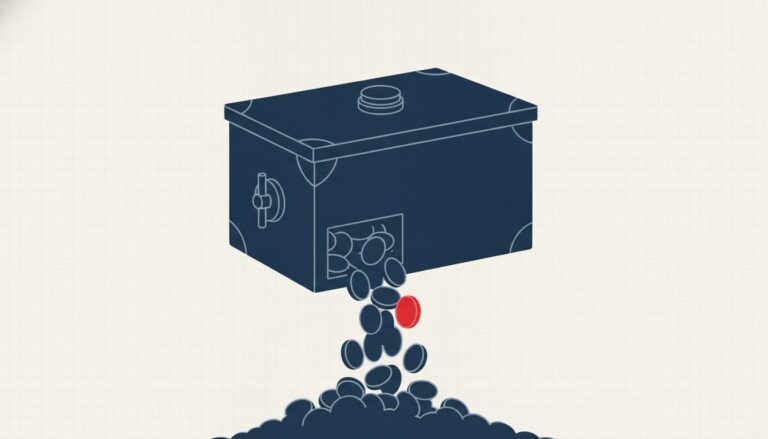
New bitcoin enters circulation through mining, a process where specialized computers compete to solve a cryptographic puzzle. The winner gets to add the next block of transactions to the chain and receives a block reward of newly created bitcoin, plus transaction fees from that block. This mechanism, called proof of work, is also what secures the network: rewriting transaction history would require redoing an enormous amount of computational work, making the ledger extremely costly to tamper with. For more on how this reward shrinks over time, see our guide to Bitcoin halvings. Roughly every ten minutes on average, one miner successfully adds a new block, and the network automatically adjusts the puzzle’s difficulty over time so that blocks keep arriving at roughly that pace regardless of how much total computing power is competing.
A fixed, known supply
Bitcoin’s protocol caps total issuance at 21 million coins, a limit enforced by the software every network participant runs, not by any company’s promise. This fixed and transparent supply schedule is central to Bitcoin’s “digital scarcity” narrative and is different from most government-issued currencies, which central banks can expand without a hard programmed ceiling. For current circulating supply and price data, see our live Bitcoin page rather than any figure baked into this guide.
What people actually use it for
Bitcoin’s use cases have evolved since 2009. Early framing emphasized peer-to-peer electronic cash; more recently, much of the public conversation has shifted toward Bitcoin as a “store of value” or inflation hedge, given its fixed supply, alongside its original use for direct value transfer without an intermediary. It’s also increasingly held indirectly through regulated products like spot ETFs, covered in our spot crypto ETF guide, rather than only through direct wallet ownership.
How US regulators currently classify it
The CFTC has consistently treated Bitcoin as a commodity, not a security, largely because there’s no central company or promoter whose managerial efforts purchasers rely on for profit — the core reasoning covered in our Howey test guide. That classification is a major reason Bitcoin was the first crypto asset approved for a US spot ETF and generally faces a different regulatory posture than many other tokens, as covered in our CFTC vs SEC guide.
Why Bitcoin is volatile
Bitcoin’s price has historically moved through large swings in both directions, often more dramatically than traditional asset classes like stocks or bonds. Contributing factors include its relatively young and still-maturing market structure, its 24/7 global trading with no circuit breakers or trading halts the way regulated equity exchanges have, sensitivity to macroeconomic conditions and interest-rate expectations, and the policy catalysts described in our policy-to-price playbook. None of this means volatility will increase, decrease, or move in any particular direction going forward; it’s a description of Bitcoin’s historical behavior, not a prediction.
How it differs from a bank account or brokerage balance
Because Bitcoin isn’t issued or backed by a government, and balances held directly in a self-custody wallet aren’t intermediated by a bank, there’s no FDIC deposit insurance or SIPC protection covering it the way there is for many traditional bank and brokerage accounts. If you lose access to your private keys, or send funds to the wrong address, there is generally no customer service line that can reverse the transaction or recover the funds. That combination of self-sovereignty and personal responsibility is core to how the network was designed, and it’s also why basic security practices, covered in our wallet security guide, matter so much for anyone holding bitcoin directly.
What owning it actually means, practically
Owning bitcoin means controlling a private key that can authorize spending funds associated with a given address on the network — whether you hold that key yourself (self-custody) or an exchange holds it on your behalf (custodial). This distinction matters enormously for security and control, and it’s covered in depth in our custodial vs self-custody guide. Whichever route you choose, the network itself doesn’t distinguish between the two; it just processes valid signed transactions, which is why the responsibility for securing access ultimately sits with whoever holds the private key at any given moment.
Not financial advice. This guide is educational and explains how a rule, market, or process works. It is not a recommendation to buy, sell, or hold any asset, and Crypto News US does not know your financial situation. Crypto assets are volatile and can lose value quickly; do your own research and consider talking to a licensed financial adviser before making decisions.
Frequently asked questions
Who controls Bitcoin?
No single company, government, or individual controls the Bitcoin network. Changes to its core protocol require broad consensus among the developers who maintain its software, the miners who secure the network, and the node operators who run it, which is part of why major protocol changes happen slowly and require wide agreement.
Is Bitcoin the same as “crypto” in general?
No. Bitcoin was the first cryptocurrency and remains the largest by market value, but thousands of other crypto assets exist with different designs, purposes, and regulatory treatment, including Ethereum, covered in our Ethereum guide.
Can Bitcoin transactions be reversed?
Generally no. Once a transaction has enough confirmations on the network, reversing it would require redoing the proof-of-work computation for every subsequent block, which becomes practically infeasible very quickly. This makes accurate transaction details important before sending funds.
Why is Bitcoin’s supply capped at 21 million?
The 21 million cap was a design choice built into the original software and preserved by network consensus ever since. It’s enforced by the rules every node independently checks, not by trust in any single party, and changing it would require a coordinated, contentious change that the broader network would have to agree to adopt.
Frequently asked questions
Who controls Bitcoin?
No single company, government, or individual controls the Bitcoin network; protocol changes require broad consensus among developers, miners, and node operators.
Is Bitcoin the same as crypto in general?
No. Bitcoin was the first cryptocurrency, but thousands of other crypto assets exist with different designs and regulatory treatment.
Why is Bitcoin's supply capped at 21 million?
The cap was a design choice in the original software, enforced by consensus rules every node checks independently.
Can Bitcoin transactions be reversed?
Generally no, once a transaction has enough confirmations, due to the computational cost of rewriting proof-of-work history.
Last updated August 12, 2026
Explainers Editor at Crypto News US, writing beginner guides, wallet-security walkthroughs and plain-English altcoin basics for newcomers, from Miami.